


Space Systems
The European Space Agency’s Hera mission - named after the Greek goddess of marriage - is Europe’s first planetary defence mission. Together with NASA's DART probe, Hera is the second part of an international effort to validate a viable method for protecting the Earth and humanity from asteroids that could threaten our planet. Its target: a binary asteroid system composed of Didymos (780m in diameter) and its moonlet Dimorphos (160m in diameter). The launch of Hera aboard a SpaceX Falcon 9 rocket from the Kennedy Space Centre in Florida (USA) will take place between October 7th at the earliest and October 27th at the latest. Thierry du Pré-Werson, Managing Director of SPACEBEL, is delighted with the Hera launch. He explains: “Hera is one of SPACEBEL's flagship projects, which perfectly demonstrates our transversal skills at all levels of a Space mission: our achievements in the context of Hera cover on-board software, simulation systems as well as the ground segment.” Thierry du Pré-Werson pleasedly concludes: ”SPACEBEL is extremely proud to be playing a major role in this pioneering mission dedicated to safeguarding our planet Earth. With more than 50 Space missions to their credit, our engineering teams are fully committed to this extraordinary project requiring cutting-edge IT technologies so as to guarantee the performance and quality of our solutions to the full satisfaction of our customers and of ESA in particular.” All details on the Hera mission: ESA Hera Launch Kit
To follow our news:
03.10.2024
SPACEBEL Expertise at the Heart of ESA’s Hera, Europe’s Very First Planetary Defence Mission
SPACEBEL is playing a key role in this bold initiative, with major software contributions at several levels.
The Hera Mission
Hera is the follow-up mission to the American DART (Double Asteroid Redirection Test), which smashed into the Dimorphos asteroid in September 2022 at a speed of 6.1 km/s, slightly deviating the celestial body's orbit (by some 1%) around its parent rock. The collision was visible with terrestrial telescopes and radar and via CubeSat images.
However, given the enormous distance at which the collision occurred, many questions remain, and the Hera mission will rendezvous with the asteroid to study the crater and post-impact effects. After a two-year journey and a flyby of Mars in March 2025, this 800kg spacecraft will reach its destination at the end of 2026. As the first ESA spacecraft to encounter a binary asteroid, Hera will study the impact aftermath, map the surface of Dimorphos in a series of close flybys, demonstrating innovative technologies such as autonomous navigation around an asteroid.
HERA will also deploy two deep space Cubesats, Milani and Juventas, both made in Europe. They have a dual objective: to collect more detailed scientific data on Dimorphos and its environment to gain a better understanding of the structure and composition of asteroids, and to evaluate a new inter-satellite link technology.
SPACEBEL & Hera

News
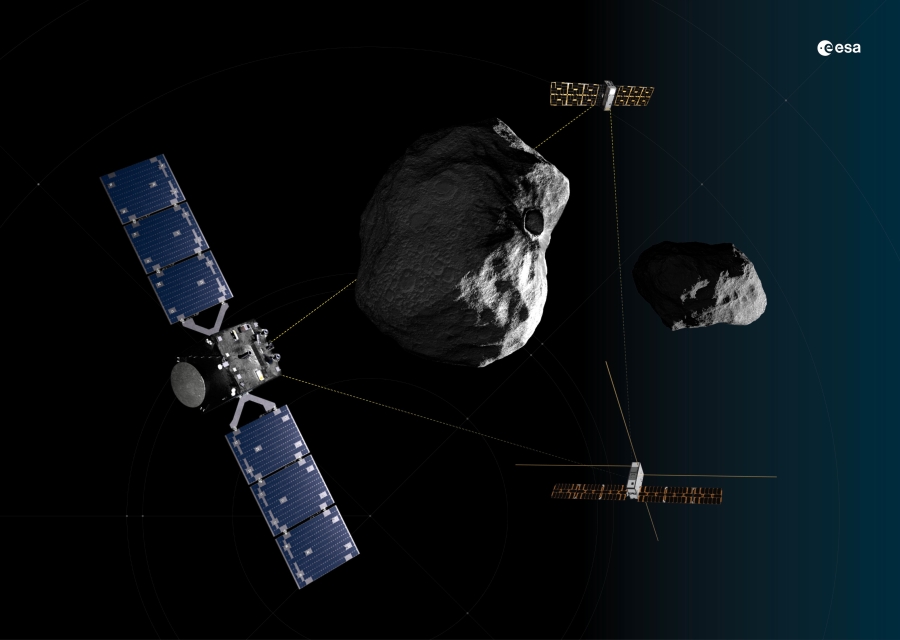
©ESA

Who We Are
Rely upon an independent and flexible SME for the delivery of mission-proven software and small satellite systems
SPACEBEL contributes to a safe and sustainable planet and inspiring space exploration by engineering solutions for the global space ecosystem.
Established since 1988, SPACEBEL is a Belgian Space systems and software engineering company that has grown in the Space market to become a trusted developer of advanced IT solutions and a provider of related IT services.
Our skills cover the design, development, integration, validation of IT space systems and geospatial information systems. Space applications are another component of our activities.
Today, SPACEBEL is in the international mix of small satellite system suppliers.
We partner with Space agencies, major aerospace prime companies, governmental bodies, EU institutions and the commercial market.

Our Values
A GREAT WORKPLACE shaped by the values of excellence, team spirit, innovation and a stimulating work environment
By joining the European Space programmes in 1988, SPACEBEL has made the deliberate choice of participating in demanding projects requiring mission critical solutions, where performance and reliability are an absolute must, where the high added value of ICT expertise plays a key role. These ambitious projects always contain technical, cost target and risk mitigation challenges and we share our customer’s objectives in this respect.
From the outset, SPACEBEL has been mindful of the development and well-being of its employees. We are convinced that everyone's passion, commitment and talents contribute to the positive development of our company. Our corporate culture relies upon strong human values, and of course, on our continuous interest in technology watch!


Are You Our Future Colleague ?
Do you want to be part of a dynamic team where cooperation is at the centre of interactions ? Ready to join a human-sized SME that operates in an innovative environment ? Have a look at our job offers !
« At SPACEBEL, I feel that we all enjoy diving into complicated Space-problems. Finding new and better ways to solve them is a common goal we achieve as a team with our customers. » (Fabien Durand – Modelling & Simulation)
Numbers
years
SPACEBEL has over 35 years of experience in the Space industry.
missions
We have participated in more than 50 different Space missions.
staff
Our consolidated team counts some 120 workers.